How to take back the biggest influence on your life
A few weeks ago I wrote about how your phone is eating your life and how all the attention-hungry systems around us are increasingly shaping what we think about, what we do and eventually what our lives look like.
That article was mainly about the problem. This one is supposed to be the answer to it:
How can I make sure I am creating the shape of my life and not societal pressure, old habits and whatever system happens to be best at getting my attention?
For that to work we need to start with where you put your attention. Not being able to do that intentionally means not being able to choose the life you want, how you want to feel or who you want to be. Yeah, it is that bad. Even if we don’t always see it.
Yielding to the fragmentation of your attention is subtle, but impactful: You feel a bit lost, exhausted, unproductive or boxed in by a life-situation you don’t truly want to be in. You are constantly doing things, but have a hard time actually thinking about whether these are the things you want to be doing. And that’s increasingly our default setting now.
Thanks Zuck.
And institutionalized socialization, but that’s a whole other article.
Understanding how your brain shapes around the things you repeatedly do allows you to see how simple it actually is to influence this process. Including how easy it is to lose that influence over it and your future.
The brain is built to make repeated actions easier, more accessible and cheaper. Things that repeatedly give you reward, relief or stimulation become more available as potential actions the next time you are in a similar state. The same applies to things that help you get away from pain, discomfort, boredom or overwhelm.
Watch your thoughts a bit and you will notice this all over the place. It’s a rather basic insight of awareness and you can ask your friends who meditate a bit too much about this:
Where does your mind go when you lack stimulation, are bored or overwhelmed? Maybe towards your phone, Google News, Netflix, email, coffee, food or work. Maybe even instead of using your lunch break for an actual moment of relaxing, calming down or reassessing your priorities.
With repetition these patterns of thinking, feeling and acting turn into habits. These, in turn, are the main factor defining the shape of your life.
This article is about how to take back control over this process. Away from all the attention-hungry systems around us and your old unintentional habits, back into the hands of the figment of consciousness reading this right now.
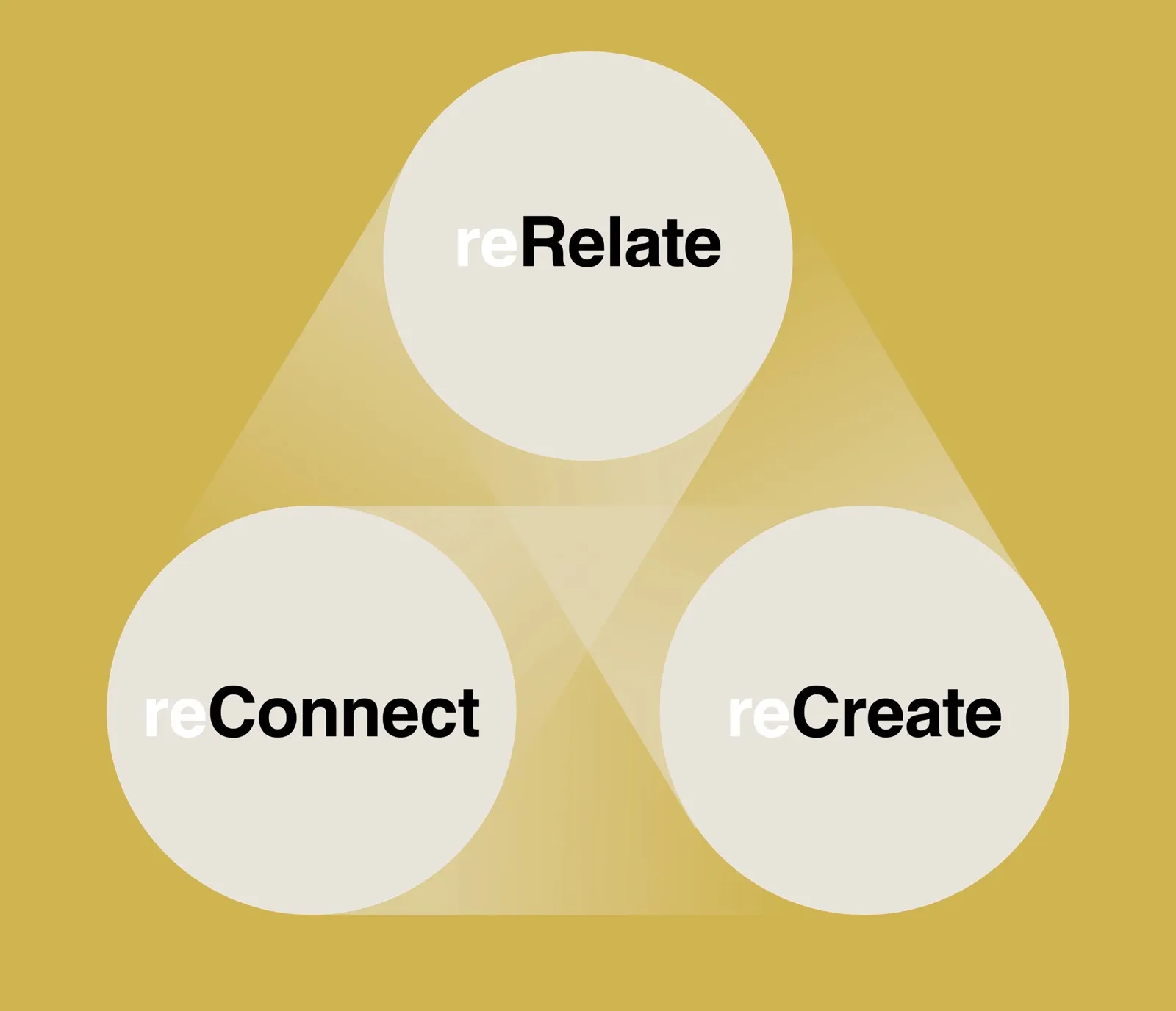
I have created a simple framework for navigating the impulses we go through constantly and it’s a foundational element of my coachings and trainings for leaders. I call it the 3Rs. It’s a core pillar of intentional — and with some work even aligned — actions.
ReConnect: feel yourself until you genuinely know what feelings are present and what impulse they are carrying.
ReRelate: remember what you want to create and who you want to be and contemplate for just a little bit on what this means for the moment you are in.
ReCreate: consider how to implement what you come up with best and then move with conviction.
So this becomes easier to relate to, here is an example of how these phases follow each other rather naturally in life.
This morning under the covers of my blanket I felt my stomach and my lingering tiredness after laying there for a bit. I imagine my coffee that I could make now and the feelings it gives me. I roll out of bed and go through the motions of weighing and brewing my Brazilian coffee beans.
From connecting with my bodily senses I relate them to coffee and my desire for it and then I create it.
This plays out all over the place.
Most of the time none of these phases happen consciously. A feeling shows up, it connects to something we already know and an action just follows. That is generally useful. It would be incredibly exhausting to deliberately decide every tiny thing we do. (“Should I scratch my arm and move my leg because it aches just a tiny bit now?”)
The problem is when these related feelings, thoughts and actions are ones we really don’t want anymore.
So, how do we use this to take control of our lives again?
Pause and practice each step deliberately. “Re”Do it until it works.
This could mean that I feel the tug of coffee but I remember that I want to drink coffee later and would like to warm up my body first. But I feel like I’m forcing myself. Not a good feeling. Here is how I stopped drinking coffee first thing in the morning:
I sit with the feeling of the coffee-pull until I feel the genuine desire for it. I then remember and connect with how great it feels when I move my body to a good song and do some easy warm-up stretches. Or how I felt after running yesterday. Then I can slowly feel the relationship to my coffee change and the pull shifts towards rolling out of bed and onto my yoga mat instead of going straight for the coffee bag and scale.
I reRelated to my first impulse.
Most importantly: I didn’t just suppress it
I let myself feel the coffee impulse, brought other relevant parts of myself and what I want into the situation and gave them a chance to become equally real. Then, this moment of peak “huh, this could be good” is the moment I choose to act upon and I reCreate the new situation I know is actually better for me.
ReConnect → ReRelate → ReCreate.
Each phase can be practiced individually.
ReConnect
Learn to feel yourself clearly and separate out noise from what is actually happening in you and what you really want.
Body scans, yoga and breathwork can help. So can open and narrow-focus meditation, following along with the “stare at the dot on the wall” trend, therapy and coaching.
The point is less which practice you use and more that you develop the ability to actually notice your internal state before immediately explaining it, changing it or distracting yourself from it.
We are often quite good at thinking about how we feel. That is not the same thing as feeling it. Feeling is something that happens in your body.
ReRelate
Understand who you want to be, in specific situations and in general. It even helps to actually write it up and read it regularly. Do work on your values. Know your vision for your life.
Otherwise there isn’t much to relate your impulses to besides the other impulses already available in your head! This clarity of vision is essential for change. It’s what you can connect to instead of the first impulse.
Practice these specific moments explicitly. Mentally rehearse going through the feelings of letting go of an initial impulse and connecting with something else that matters to you. I have noticed that even turning the shower to cold is much less intense when I first mentally rehearse going through the process and feeling the resulting satisfaction at the end! This works in many situations you might want to avoid.
This is not necessarily about replacing a “bad” impulse with a “good” one. It is about making more of yourself available in the moment before you act. Activating the parts of you that move you elsewhere.
You might still choose the first impulse afterwards. That’s fine.
But now you actually chose it!
ReCreate
At some point you need to turn what you came up with into movement.
Start the movement before even thinking about it, if possible. Just start. Then practice doing it.
The more often an action becomes the result of the way you want to relate to a situation, the more available that action becomes the next time around. Eventually some of the things that initially required quite a bit of attention stop requiring as much of it.
Which brings us to something I think is far more important than it tends to look:
Down phases are necessary.
Not for some mythical dopamine detox, but for the state of mind that enables true choice.
Slowing down enables more fine and deliberate movement, even when it’s unpracticed. Anyone learning to play songs on an instrument understands this intuitively. When you can’t execute something properly at full speed you slow it down enough that you can actually notice what you are doing, make corrections and try again.
This also applies to making choices and following through.
If every spare thirty seconds gets filled, you remove a lot of the circumstances in which this can happen.
You feel something uncomfortable and reach for your phone. You get bored and check your messages. You have seven minutes between meetings and open Instagram. You eat lunch while watching your favorite YouTuber. You walk somewhere while listening to a podcast.
None of these things are particularly problematic on their own. I do them too.
The problem is what happens when there are almost no moments left without them. When you’re never just feeling yourself.
Actual pauses are never wasted time. They are either time to regenerate — even just seconds help — or chances to reflect, evaluate and readjust. They are the core of learning to navigate life instead of simply running faster in whatever direction you are already going.
And they are the exact thing your phone, inbox and automated booking tools are eating up like ravenous bit-based hyenas feasting on a kill after successfully chasing away the lion of intentional life choices.
Because the 3Rs require at least some space.
Not necessarily much space but definitely some of your mental real-estate.
ReConnect requires enough time to slow down and notice what is happening.
ReRelate requires enough time for something other than the first available impulse to enter your field of awareness.
ReCreate requires a moment in which you can actually move with that new relationship before the old one simply takes over.
That means taking back control over your attention is not mainly about becoming better at resisting your phone.
It is about becoming better at connecting with your self in the moment, remembering what you are trying to create and giving yourself enough space to make these things matter in small and big situations.
The next time you find yourself automatically reaching for your phone, opening another tab, checking the news or doing whatever your particular version of this is, you don’t even have to stop yourself.
Just notice it.
What am I feeling?
What is the impulse?
What does this connect to?
What else do I want this moment to connect to?
And what do I want to create from here?
Sometimes the answer might still be Netflix.
That’s fine.
The point isn’t that every moment now has to become some optimized act of intentional living. That sounds exhausting and honestly quite unpleasant.
The point is that you were there for the decision.
Because these moments become actions. Actions repeated often enough become habits. Habits make some paths through your life easier and others harder to find.
And after enough time those paths start looking like your work, your relationships, your health, what you think about, what you believe yourself capable of and what you actually spend your life doing.
That is quite a lot of your life being shaped in moments that are very easy to overlook.
So create some space for them.
ReConnect.
ReRelate.
ReCreate.
And “Re”Do it until the shape that emerges is increasingly one you actually recognize as true to yourself.